

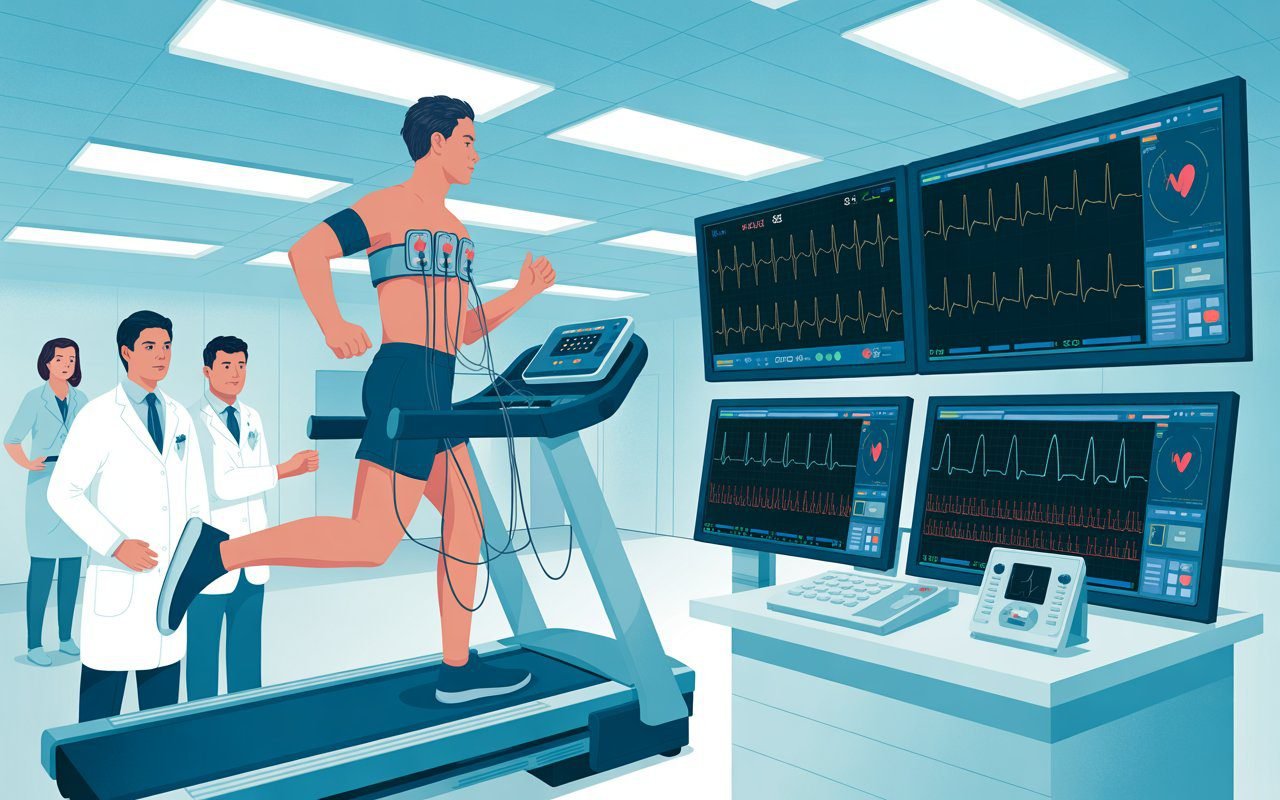
What Stress Eletrocardiograma Shows
A standard ECG records electrical patterns only while the body rests. Stress Eletrocardiograma records rhythm during exercise. The difference seems simple, but the insight is powerful. An athlete who shows a normal tracing at rest may reveal subtle irregularities during exertion. For example, a hidden arrhythmia may activate only during increased heart rate. Stress ECG reveals these events clearly.
This difference is why stress testing is used in sports cardiology programs around the world. Baseline results are useful but do not represent competition conditions. Exercise ECG simulates real performance and shows how the heart works when power and endurance are required. For a wider overview of test formats, you can read about ECG types.
How Stress Eletrocardiograma Works
The test begins with electrode placement similar to a routine ECG. The athlete then walks or runs on a treadmill or cycles on an ergometer. Every few minutes, intensity rises. Speed may increase or incline may elevate. Throughout the activity, electrical conduction is recorded in real time. This shows exactly how the heart adapts to changing physical demand.
The test may end when a training threshold is reached or if rhythm shows a variation that needs attention. Recovery period is also recorded because how quickly the heart returns to baseline is a major indicator of cardiovascular fitness. Fast recovery usually means strong conditioning. Slow recovery may signal stress response that needs structured training plan adjustment.
Who Should Consider Stress Eletrocardiograma
Competitive athletes benefit strongly from stress ECG. Endurance runners, cyclists, swimmers, football players, sprinters and high intensity interval athletes often use exercise ECG as part of performance assessment. Recreational athletes who increase training after a long break can also benefit. Stress Eletrocardiograma is especially useful for athletes who experience palpitations, early fatigue, chest tension or unusual breath sensation during training.
For an overview of who generally needs cardiac evaluation, you may explore who should ECG. In some cases, stress ECG is also recommended for very active people with risk factors for heart attack, especially when chest discomfort appears with exertion.
What Stress ECG Can Detect
Stress Eletrocardiograma can reveal patterns that resting ECG misses. These include:
- Exercise induced arrhythmia
- ST segment depression or elevation under load
- Prolonged QT during peak performance
- Recovery delay after exertion
- Hidden conduction block patterns
- Oxygen deficit response indicators
Not all findings require treatment. Many findings simply guide training intensity or hydration strategy. The goal is to identify early and respond smartly.
Stress ECG vs Rest ECG
Rest ECG provides a snapshot. Stress ECG provides a full motion recording. The athlete’s heart behaves differently when muscles demand oxygen and circulation accelerates. This makes stress testing a more realistic reflection of sports conditions.
For baseline athletic screening information, read athlete ECG. Rest testing and stress testing together give the clearest picture of how the heart responds both in calm and in effort.
Benefits for Performance and Safety
Athletes train best when they understand their heart. Stress Eletrocardiograma improves training precision. It helps athletes avoid pushing into dangerous fatigue zones, while also proving when the heart is strong enough to advance intensity. Knowledge prevents injury and enhances peak performance.
Psychologically, Stress ECG creates confidence. An athlete who knows the heart responds properly under pressure competes more freely and recovers more efficiently. The mind becomes stronger when the heart is understood.
Training Adjustments Based on Results
If stress ECG results look ideal, the athlete can progress at full potential. If a variation appears, the training plan may shift toward controlled pacing, interval balancing, electrolyte replenishment or rest cycle optimization. This creates sustainable athletic development rather than overloading the heart in early stages.
Some training programs integrate stress ECG every season to track improvements and verify that heart rhythm adapts well to evolving intensity.
Mayo Clinic offers long standing cardiovascular education for athletes and active people at mayo clinic, where readers can learn about exercise heart safety and performance awareness.
Additional fitness focused cardiovascular information is available from the American Heart Association at heart org, offering general training guidance that supports long term heart health.
When to Repeat Stress ECG
Annual or seasonal retesting is useful for competitive athletes. Stress Eletrocardiograma repetition is helpful when:
- Training intensity increases sharply
- Performance plateaus without clear reason
- Palpitations appear during workouts
- Recovery time slows
- Family risk history becomes relevant
Final Summary
Stress Eletrocardiograma for athletes and active people reveals how the heart performs under real physical demand. It detects changes that resting screening cannot see. When results are normal, athletes train with confidence. When variation appears, improvements begin early before risk develops. The test does not hold athletes back. It builds smarter performance, stronger durability and long term cardiovascular safety.